
The published project record
Valverde’s past-projects page identifies the 2CO Don Valley Project in Yorkshire. Its CEO biography describes 2CO engineering a complete carbon-capture project at a UK coal plant, with the captured CO₂ intended for a North Sea oil field.
The biography states that the UK government elected not to fund the project through completion in the prevailing economic conditions. It connects this experience to Gareth Roberts’s subsequent formation of Valverde.C09
Connection to Valverde
2CO was founded by Valverde CEO Gareth Roberts. Don Valley is presented here as earlier team experience.
Project at a glance
- Location
- Yorkshire, United Kingdom
- Organization
- 2CO Ltd
- Focus
- Power generation with carbon capture and a proposed North Sea CO₂ destination
- Record
- Historical project experience
Follow the power. Follow the carbon.
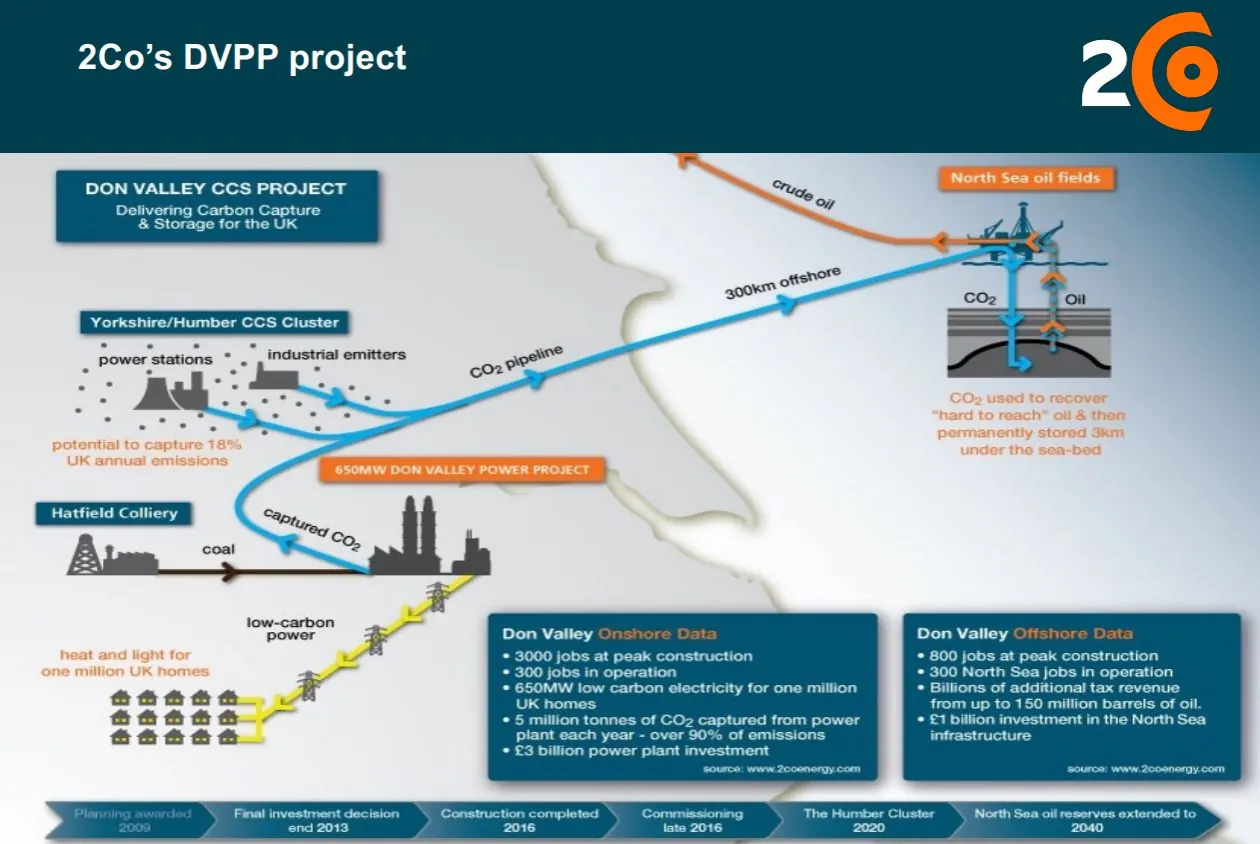
Explore how the proposed plant, regional industry and North Sea infrastructure were intended to connect.
Power with a carbon pathway
The original Don Valley concept, redrawn for exploration.
Select a stage to explore the proposal
Don Valley Power Project
The proposed coal-fuelled plant at Hatfield, Yorkshire, was designed to generate electricity with carbon capture. The original illustration identified Hatfield Colliery as the coal source.
650 MWPlanned power output in the original proposal
Power for the grid
The electricity pathway connected the proposed Don Valley plant to UK electricity users. The green flow shows the power route separately from the captured-carbon route.
One million UK homesElectricity supply described in the original proposal
Connect generation with carbon capture
CO₂ captured from the proposed plant would enter the transport system. The original concept also showed a potential Yorkshire/Humber cluster connecting other power stations and industrial emitters.
5 million tonnes/yearPlant capture estimate; over 90% of plant emissions
A proposed North Sea CO₂ route
The blue flow traces the proposed pipeline from Yorkshire toward North Sea oil fields. The route is shown schematically; the original illustration labeled an offshore distance of 300 km.
300 kmOffshore distance shown in the original graphic
Injection below the seabed
The proposal paired CO₂ injection with enhanced oil recovery and subsequent geological storage. Blue flows move downward into the reservoir; the amber flow shows the proposed oil-recovery route upward.
3 kmStorage depth illustrated in the original proposal
The proposed project timeline
Dates reproduced from the original 2CO illustration. It described planning as awarded in 2009; the later milestones were proposed targets, not a record of completed delivery.
2009 · Planning awarded
The illustration starts with planning awarded in 2009. This is the starting point of its proposed development schedule.
End 2013 · Final investment decision
The original schedule targeted a final investment decision at the end of 2013. Its investment estimates were £3 billion for the power plant and £1 billion for North Sea infrastructure.
2016 · Construction completed
Construction completion was targeted for 2016. The illustration estimated 3,000 onshore jobs and 800 offshore jobs at peak construction.
Late 2016 · Commissioning
Commissioning was targeted for late 2016. The proposed plant was rated at 650 MW, described as power for one million UK homes, with 5 million tonnes of CO₂ captured each year—over 90% of plant emissions.
2020 · The Humber Cluster
The schedule placed the Humber Cluster in 2020. The wider Yorkshire/Humber concept connected power stations and industrial emitters; the illustration described potential capture equivalent to 18% of UK annual emissions.
2040 · North Sea oil reserves extended
The illustration projected extending North Sea oil reserves to 2040 through CO₂-assisted oil recovery, followed by permanent storage below the seabed. It cited up to 150 million barrels of oil and “billions” in additional tax revenue.
The proposal in numbers
Historical design estimates, not current employment, investment or operating results.
Don Valley onshore
- Jobs at peak construction
- 3,000
- Jobs in operation
- 300
- Lower-carbon electricity
- 650 MW for one million UK homes
- CO₂ captured from the plant
- 5 million tonnes/year over 90% of plant emissions
- Power plant investment
- £3 billion
Don Valley offshore
- Jobs at peak construction
- 800
- North Sea jobs in operation
- 300
- Potential oil recovery
- Up to 150 million barrels
- Additional tax revenue
- “Billions” as described in the original illustration
- North Sea infrastructure investment
- £1 billion
An animated explanation of 2CO’s historical proposal. Figures describe the original design, not completed infrastructure or current operating results. Source: Valverde’s published project illustration.
View the original project illustration
Sources
Valverde’s past-projects page · Gareth Roberts’s published biography
Explore Rio Bravo, also listed in Valverde’s historical project record.