
Home › Projects › Hestia Project
Project recordHestia Project
Utilizing oxy-fuel power generation to decarbonize upstream oil-field operations — a preliminary front-end engineering design (pre-FEED) for two North American projects, announced 22 February 2023.
What was announced
On 22 February 2023, Valverde Power Solutions, MISC Berhad, Clean Energy Systems and Aker Solutions announced that the Hestia Project had commenced pre-FEED to assess and demonstrate two emission-free power projects using CES’s oxy-fuel burner technology, licensed by Valverde. The announcement was also published by MISC.
Hestia Canada
Pipeline-quality natural gas at an enhanced-oil-recovery operation.
Canadian project profile →Hestia U.S.
A CO₂-contaminated natural-gas return stream at an enhanced-oil-recovery operation.
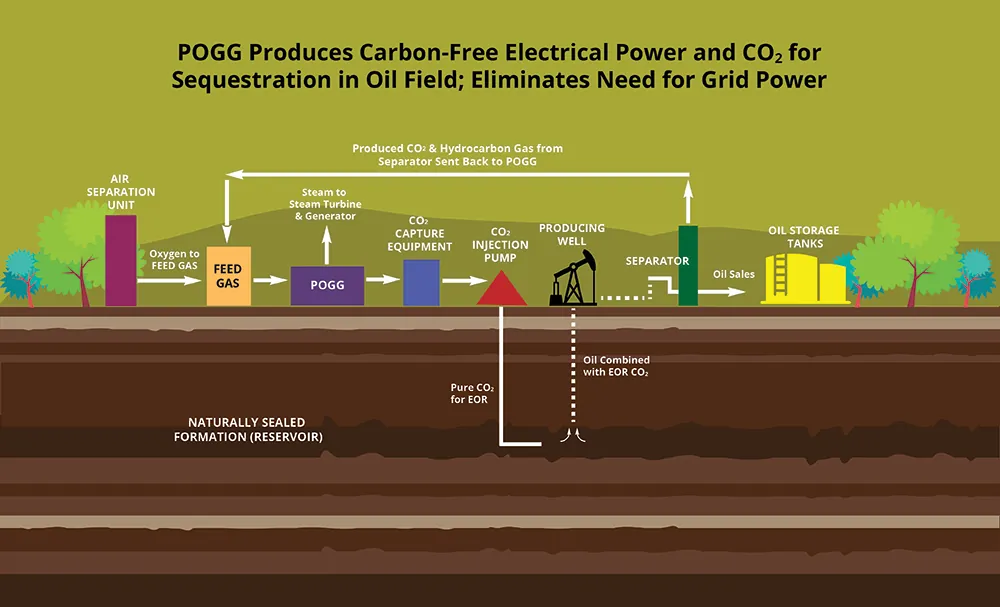
U.S. project profile →On completion, each project was intended to generate carbon-free electrical power for oil-field operations and for sale to the grid, with the CO₂ sequestered in the oil and gas reservoir. The scalable CES solution was described as designed to provide 10 MW to 100 MW to match the customer’s requirement. Valverde served as project manager for both projects.
Reading this record. This page records the February 2023 announcement as made, including its anticipated first-facility date of 2025. Valverde has not published a subsequent status update for the Hestia projects, and this page does not infer one. Valverde’s currently described project is the Alberta gas-plant decarbonization.C06
Participants and roles
- Valverde Power Solutions
- Project manager; technology licensee; developer
- Clean Energy Systems
- Oxy-fuel technology owner and developer, Rancho Cordova, California
- MISC Berhad
- Malaysian international shipping and energy-infrastructure company; consortium participant
- Aker Solutions
- Norwegian engineering and service company; consortium participant
Roles as described in the 2023 announcement. This page does not state the current participation or commitments of any party.C07
Why EOR operations were chosen
- Fields injecting CO₂ already use significant electricity, mostly from the grid, for compression and recirculation
- Combustion CO₂ from the oxy-fuel unit adds to the CO₂ available for injection, extending the economic life of reserves
- Grid draw is reduced or eliminated; stack emissions from field power are removed
- Potential eligibility for carbon credits and investment tax credits in Canada, and for 45Q and LCFS in the US — subject to project-specific determination
Read as 2023 screening estimates
The release described an initial inventory of 28 identified opportunities, an estimated US$4.6 billion of capital requirements and roughly 8.6 million tonnes per year of potential CO₂ impact. These were company estimates at the time of screening. They are not a current backlog, secured revenue, financed assets or demonstrated outcomes, and this site does not present them as such. company screening estimate · Valverde · February 2023C10
Operate a CO₂ EOR field?
The Hestia configuration — field gas to power, combustion CO₂ to the reservoir — is directly relevant. A Project Fit Review is the first step.